

To write your last will and testament, inventory your assets, choose beneficiaries, name an executor, appoint guardians for dependents, then sign in front of two adult witnesses. Every state allows you to write your own will, and a simple will costs $0 to $300 online or $300 to $1,200 through an attorney. A living will cover medical wishes separately.
Someone you love will one day open a drawer looking for answers about what you wanted. A clear last will and testament puts those answers in their hands, yet most American adults still do not have one. The good news is that writing a testament is far simpler, faster, and cheaper than most people expect.
What Is a Will?
A will, formally called a last will and testament, is a legal document that states who receives your property after you die. It also names an executor to carry out your wishes and can appoint guardians for minor children or dependent adults.
Without a will, state intestacy laws decide who inherits, and the court chooses who manages your estate. Those default rules rarely match what families actually want.
Types of Wills to Consider
Before you start writing, it helps to know the main types of wills and which one fits your situation. Most people only need a simple will, which distributes assets directly to named beneficiaries without complex trust structures.
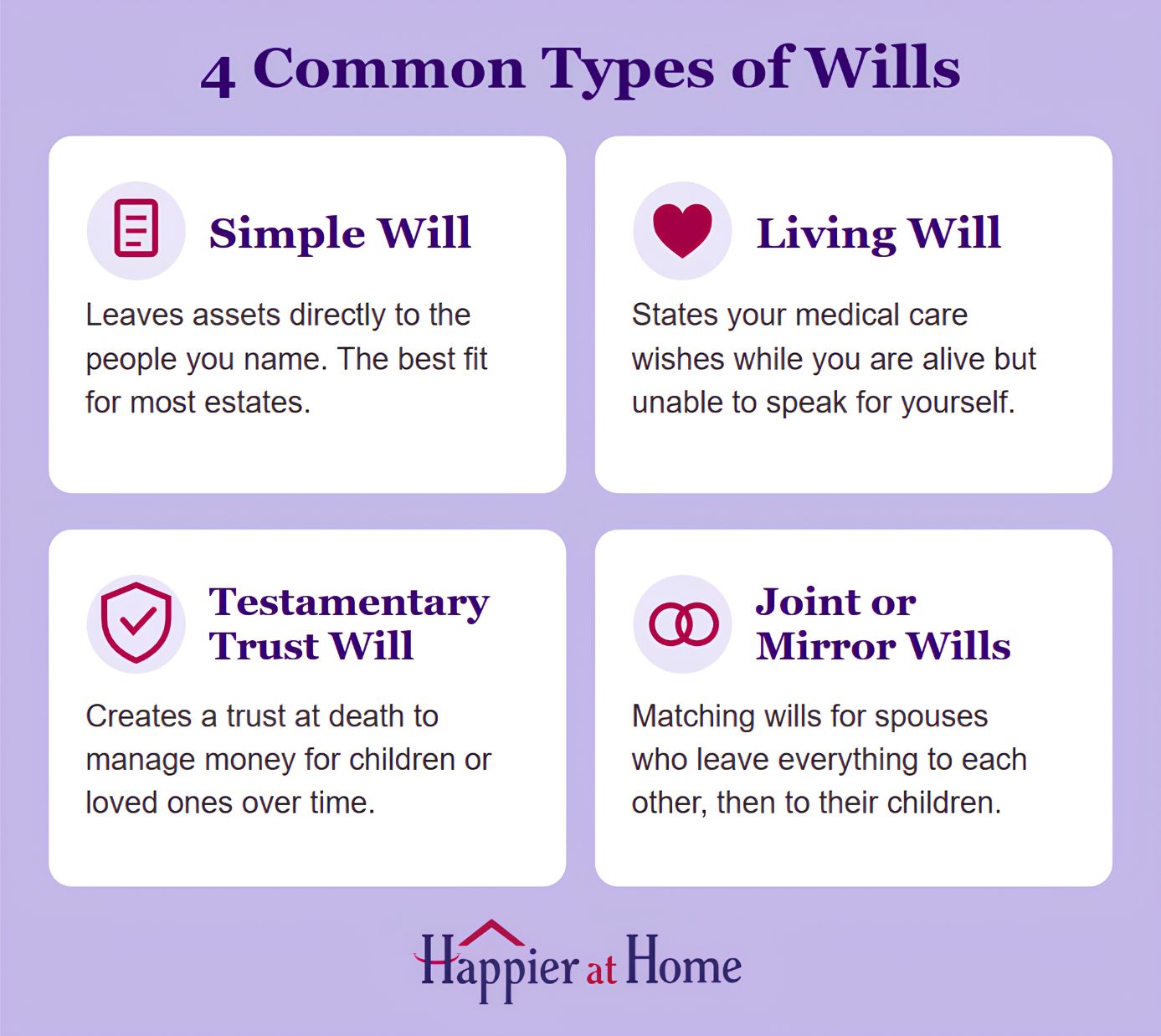
Why You Should Have a Will & Testament
A will is the only document that lets you, not a probate judge, decide where your property goes. It also speeds up settlement, since a clear will can cut months off the court process and keep legal fees down.
Just as important, it prevents conflict. Families rarely argue when wishes are written down, signed, and witnessed, and that clarity is one of the kindest gifts you can leave behind.
How to Know if You Should Have a Will
Here is the short version: if you are an adult, you should have one. Wills are not just for the wealthy, and waiting for the “right time” is how most families end up in probate court with no instructions.
A will matters even more if any of these apply to you:
- You own a home, vehicle, savings, or family keepsakes you want to direct to specific people
- You have children, grandchildren, or a dependent adult in your care
- You are married, remarried, or have a blended family
- You are a caregiver, or you receive support like companion care for seniors and want your wishes documented while you can express them clearly
Can You Write Your Own Will?

Yes. Every state recognizes a self-prepared will as long as it meets that state’s legal requirements. In most states that means you are at least 18, of sound mind, and you sign the document in front of two adult witnesses.
Cornell Law School’s Legal Information Institute offers a plain-language overview of what makes a will valid. Requirements vary by state, so always check your own state’s rules before signing.
Do You Need a Lawyer to Make a Will?
No, you do not need a lawyer to make a will. Learning how to make a will without a lawyer is realistic for most people with straightforward estates, especially with reputable online will services that walk you through each step.
An attorney becomes worth the fee when things get complicated. Consider professional help if you own a business, have a blended family, expect someone to contest the will, or hold significant assets across multiple states.
How Much Does It Cost to Create a Will?
Cost is the reason many people put this off, and it should not be. Writing a will can cost nothing at all, and even attorney-drafted documents are a small price compared to the cost of probate confusion later.

Prices vary by region and by how complex your estate is. Ask any attorney for a flat fee quote up front so there are no surprises.
How to Write Your Own Will and Testament: Step by Step
Here is exactly how to write your last will and testament, from blank page to signed document. Follow these seven steps in order and set aside about an afternoon.
- Inventory your assets. List your home, vehicles, bank and retirement accounts, insurance policies, digital accounts, and meaningful personal items.
- Choose your beneficiaries. Decide who receives each asset, and name backup beneficiaries in case someone passes before you.
- Name an executor. Pick a responsible person you trust to settle your estate, and confirm they are willing to serve.
- Appoint guardians. If you have minor children or a dependent adult, name a guardian and an alternate in writing.
- Put it in writing. Type the document or use a state-specific template, using clear full legal names for every person mentioned.
- Sign with two witnesses. Sign in front of two adults who are not beneficiaries, and consider a notarized self-proving affidavit to speed up probate.
- Store it and tell someone. Keep the original in a safe place and make sure your executor knows exactly where it is.
That is the full process for how to write a will without a lawyer. If your situation is more complex, complete these steps anyway, then bring your draft to an attorney for a review rather than starting from zero.
One more tip for families managing daily support needs. If a loved one relies on personal care services or medication management, keep a copy of the care plan with the estate documents so the executor understands the full picture.
How to Create a Living Will
A living will works differently from a last will and testament. It documents the medical treatment you do or do not want if you become unable to communicate, such as decisions about resuscitation, feeding tubes, and comfort care.
Learning how to create a living will follow a similar path: get your state’s advance directive form, record your treatment preferences, name a health care agent, and sign per your state’s witnessing rules. The National Institute on Aging publishes free guidance on preparing a living will that walks through each document.
These conversations matter most for families arranging end-of-life support like in-home hospice care, where written wishes spare loved ones from guessing during the hardest moments. A senior care advocate can also help families organize these documents and communicate them to doctors and care teams.
Your Will Is an Act of Love

Writing a testament is not about dwelling on the end. It is about protecting the people you love from confusion, conflict, and court delays at the worst possible time.
Set aside one afternoon this month, follow the seven steps above, and get it signed. Then talk with your family about the bigger plan, including support at home through trusted senior home care services, from a few hours of in-home respite care each week to full 24 hour home care.
Frequently Asked Questions
Is a handwritten will legal?
In some states, yes. A handwritten document, called a holographic will, is accepted in roughly half of U.S. states, though it usually must be entirely in your handwriting and is easier to challenge than a witnessed, typed will.
Where should I store my will?
Keep the signed original in a fireproof home safe, with your attorney, or filed with your county’s probate court if your state allows it. Avoid a bank safe deposit box unless your executor already has access, since boxes can be sealed at death.
Who can witness a will?
Any competent adult who is not a beneficiary can serve as a witness in most states. Using a beneficiary as a witness can void their gift or invite a challenge, so choose neutral parties like neighbors or coworkers.
Does a will avoid probate?
No. A will guides the probate process rather than skipping it. Tools like beneficiary designations, joint ownership, and living trusts are what move assets outside of probate.
Can I disinherit a family member?
Generally you can disinherit adult children by stating it clearly in the will, but most states protect a surviving spouse from full disinheritance. Name the person and state your intention directly so the omission cannot be read as a mistake.
This content is for informational purposes only and does not constitute legal advice. Consult a licensed attorney in your state for guidance on your specific situation.
Watch our Weekly Happier at Home Segment on FOX
Published June 2024 · Last updated July 2026
This content is for informational purposes only and does not constitute legal advice.